Showing posts with label Robert Ehrlich. Show all posts

Sunday, December 19, 2010

Investigators Raid Home of Ehrlich Robocaller

In case you missed the Baltimore Sun story. Attorney General Doug Gansler says enough is enough and has filed a civil lawsuit:

Maryland Attorney General Douglas F. Gansler has filed a civil lawsuit against Henson, alleging voter intimidation and vote suppression.

Gansler’s complaint alleges that Henson and an employee violated the Telephone Consumer Protection Act by because the phone message did not include any identifying information. Gansler is seeking $500 for each violation, which would add up to a fine of more than $56 million
It appears, however, that Republicans think that don't ask, don't tell isn't only for gays in the military:

Henson said Ehrlich “probably” did not know about the calls. Ehrlich’s campaign paid Henson $111,000 for “community outreach.”

Ehrlich told the Annapolis Capital last week that the calls were “done outside of my purview.” When news of the calls broke on Election Night, an Ehrlich spokesman called them “absolutely irresponsible.”

Read More...

Wednesday, November 03, 2010

Governor's Race by County: Third Cut

A decisive win for Governor Martin O'Malley.

Read More...

Tuesday, November 02, 2010

Governor's Race by County: Second Cut

Read More...

O'Malley Has Huge Early Lead on Ehrlich

Here's the first summary of election returns by county on the Governor's race.

Read More...

MPW Reader Poll: Governor's Race

Read More...

Our Forecast: Ehrlich vs. O’Malley

Who’s going to win the Maryland Governor’s race today? We know the answer, so read on to find out!

OK, we don’t know the answer, but we are going to take our best shot at predicting the outcome. And we will not do it using party talking points, ideology, impassioned appeals or all that other pap. We will rely on what truly matters on Election Day: mathematics.

Our projections are derived from three sets of estimates:

1. Registration by party
2. Turnout by party
3. Voting intention by party

Of these three, only registration is known. Here is the number of voters by party who are eligible to vote in today’s general election.


Registration alone will not determine the election. Here are the turnout rates by party for the last three gubernatorial general elections, as well as a forecast by Gonzales Research in its latest poll.
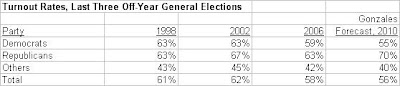

Democrats and Republicans turned out at about the same rate in 1998. Since then, Republicans have had a four-point edge. Independents and members of other parties are much less likely to vote. Gonzales estimates that 2010 will be a very different year for turnout and we will discuss that later.

Now here is Bob Ehrlich’s support by party in four different polls.

1. A Survey USA poll taken in November 2002 48 hours before the election. This shows Ehrlich’s support by party in the year that he won.

2. A CNN exit poll taken in November 2006. This shows Ehrlich’s support by party in the year that he lost.

3. The average levels of Ehrlich’s support by party from three October 2010 polls by Gonzales, the Baltimore Sun and the Washington Post.

4. Ehrlich’s support by party from a July 2010 poll by Magellan. This poll, which showed Ehrlich up three points on O’Malley, was Ehrlich’s best poll of the cycle.

Every poll had undecideds except the CNN exit poll. We allocated undecided voters with their party and split independents down the middle so as not to understate Ehrlich’s support.


Taken together, these sets of numbers can be used to construct projections for the race. By plugging in different sets of assumptions about turnout or party voting behavior, we can estimate a range of outcomes for both Ehrlich and O’Malley. We assembled three models.

General Election Model One

In our first model, we assume that turnout will be the same as in 2002 (which was the year Ehrlich won) and that party members will vote in accordance with the average of the three October 2010 polls. The outcome under these assumptions is an 18.4 point blowout for O’Malley.


Now, this is not going to happen. The primary reason is Democratic turnout. The number of registered Democrats eligible to vote in the general election has gone from 1.557 million in 2002 to 1.957 million today. Many of the new Democrats registered during the run-up to President Obama’s election. It is unreasonable to expect all of them to turn out at the same rate as the older, long-term Democrats. Furthermore, Gallup is forecasting heavy turnout nationwide for the GOP. No pollster expects that Republicans will have a four-point turnout edge this year. It’s far too narrow for today’s wave election.

General Election Model Two

In our second model, we are using Gonzales’s turnout forecast – 70% for Republicans, 55% for Democrats and 40% for others – along with the October poll party voting assumptions. Gonzales’s forecast provides for an unprecedented GOP edge in Maryland, but given what happened in the primaries, it is probably justified. Primary election day turnout for Maryland Democrats was 37% in 2002, 33% in 2006 and 25% this year. Primary election day turnout for Maryland Republicans was 30% in 2002, 25% in 2006 and 29% in 2010. That’s a HUGE dropoff for Democrats that has party leaders concerned. The outcome under these assumptions is a 13.2 point win for O’Malley.


O’Malley still wins big because Ehrlich’s support among Democrats is so low. As we showed yesterday, the four most recent polls showed Ehrlich getting just 7-19% of Democrats – far less than the 29% he scored right before the 2002 election. But what if critics of these polls like Blair Lee are right? What if survey problems are underestimating Ehrlich’s appeal to Democrats?

General Election Model Three

The best poll for Ehrlich in the entire cycle was Magellan’s July 2010 survey, which showed him getting 25% of Democrats and winning by three. Magellan works primarily for Republicans, so their estimates may be the best that Ehrlich will ever get. Also, this poll was taken before most of O’Malley’s attack ads hit. In our third model, we use Gonzales’s turnout forecast and Magellan’s party voting estimates. Under these assumptions, O’Malley wins by 1.8 points.
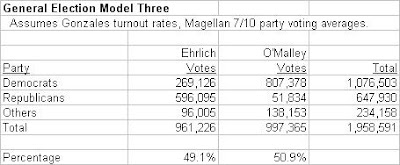

This illustrates Ehrlich’s fundamental problem: even under the most favorable turnout and party voting assumptions, he loses. He is not matching the appeal he had to Democrats in 2002 and the GOP is not large enough to carry him to victory.

So what will be the margin? Model One is totally unrealistic. Model Two is too lenient to the Democrats. Model Three is too lenient to the Republicans. So let’s split the difference between Models Two and Three.

O’Malley by 7.5.

Read More...

Monday, November 01, 2010

The Infamous "Ehrlich-Steele Democrats" Flyer, 2006

This is one of the most notorious campaign lit pieces in Maryland history: the "Ehrlich-Steele Democrats" flyer from 2006. The Ehrlich and Steele campaigns bused in homeless people from Pennsylvania and Delaware to distribute these "voter guides" in Prince George's County. Then-First Lady Kendel Ehrlich even greeted them as they emerged from the buses to hand out the lit! Former Ehrlich aide Joe "Prince of Darkness" Steffen calls the incident a disaster.


Here is some video of the poll workers.


Does Ehrlich have anything like this planned for tomorrow?

Read More...

How Many Democrats Will Vote for Ehrlich?

Tomorrow’s gubernatorial contest between Bob Ehrlich and Martin O’Malley will depend on two things: turnout and the percentage of Democrats voting for Ehrlich. We’ll address turnout in tomorrow’s election forecast. Today, we’ll focus on Ehrlich Democrats.

Bob Ehrlich, and any statewide candidate, needs to have Democratic votes to win. That’s because of the Democrats’ immense edge in voter registration. Democrats account for 56.4% of all voters eligible to vote in the general election, a percentage that has changed little in the last decade. Republicans account for 26.7% of all voters eligible to vote in the general election, down from 30.1% in May 2004.


How many Democrats are willing to vote for Ehrlich? Let’s look at the history of polling in the three gubernatorial races in which Ehrlich has participated. Not all polls release cross-tabulations, and many of the older ones are no longer online, but this is our best shot at a roundup.

Percentage of Democrats Supporting Ehrlich, 2002 Cycle

Gonzales, September 2001: 11%

Gonzales/Arscott, January 2002: 16%

Gonzales, July 2002: 18%

Gonzales, August 2002: 21%

Gonzales, September 2002: 24%

Gonzales, October 2002: 25%

Survey USA, November 2002: 29%

Ehrlich, who was then a Baltimore County Congressman, started this race with less name recognition than Lieutenant Governor Kathleen Kennedy Townsend. But as the election season went on, his poll numbers went up – driven largely by steady gains among Democrats. The last Survey USA result, taken 48 hours before the election, reflects the current conventional wisdom that Ehrlich can win with 30% support among Democrats. Ehrlich defeated Townsend by 3.9 points.

Percentage of Democrats Supporting Ehrlich, 2006 Cycle

Gonzales, April 2006: 16%

Survey USA, September 2006: 16%

Survey USA, October 2006: 16%

Survey USA, November 2006: 18%

CNN Exit Poll, November 2006: 15%

Ehrlich stayed in the mid-teens among Democrats for most of the election season. Given that performance, he was unable to close the gap against Baltimore Mayor Martin O’Malley even with decent job approval ratings. O’Malley defeated Ehrlich by 6.5 points.

Percentage of Democrats Supporting Ehrlich, 2010 Cycle

Gonzales, January 2010: 16%

Magellan, July 2010: 25%

Public Policy Polling, July 2010: 21%

Gonzales, July 2010: 19%

Washington Post, September 2010: 10%

Gonzales, October 2010: 17%

Baltimore Sun, October 2010: 17%

Washington Post, October 2010: 7%

Two polls in July showed Ehrlich breaking 20% among Democrats. The Public Policy Polling survey showed Ehrlich trailing O’Malley by three points and claiming 21% support among Democrats. The Magellan poll showed him with a three-point edge over O’Malley and 25% support among Democrats. (It’s worth noting that Magellan works primarily for Republicans.) Since then, five polls have shown Ehrlich’s Democratic support varying between 7% and 19%. That’s in the neighborhood of his losing reelection campaign in 2006.

But 2010 is a wave year for the GOP. Can Ehrlich make it up in Republican turnout? We’ll find out tomorrow.

Read More...

Sunday, October 31, 2010

Brian Murphy on Bob Ehrlich

Read More...

Saturday, October 30, 2010

LCV Compares Ehrlich and O'Malley on the Environment

The Maryland League of Conservation Voters (LCV) has released this video comparing the environmental records of Bob Ehrlich and Martin O'Malley.

Read More...

Friday, October 29, 2010

Bob Ehrlich: The Anti-MoCo Candidate, Part Three

Bob Ehrlich depicts himself as a tax cutter. Isn’t that good for Montgomery County?

It depends on which taxes you’re talking about.

Taxes

Ehrlich has made criticism of Governor O’Malley’s 2007 special session tax package a centerpiece of his campaign. His primary tax proposal is to repeal the special session’s one-cent increase in the sales tax, which accounted for a majority of the tax package. Ehrlich characterizes the sales tax as regressive. It certainly is, but these are crocodile tears from the former Governor. He expressed his real feelings about the working class by closing the state office that enforced child labor, minimum wage and other labor standards in 2005.

If Ehrlich does repeal the sales tax increase, who would benefit the most? The following chart illustrates per capita sales tax payments for every Maryland county (as well as Baltimore City).


In FY 2009, the average Maryland sales tax paid per capita was $591. That amount was highest in tourist centers like Ocean City (in Worcester County) and Saint Michaels (in Talbot County) and in Central Maryland jurisdictions like Anne Arundel and Howard Counties. MoCo’s per capita sales tax payment ($543) is actually 8% less than the state average, so MoCo gets relatively little out of this tax cut – especially given how Ehrlich would pay for it. (More on that later.)

Ehrlich does not have much of a record of cutting taxes, but he does have a record of raising one tax in particular: the state property tax. In 2003, Ehrlich voted in favor of a property tax hike from 8.4 cents to 13.2 cents for every $100 in assessed value on the Board of Public Works. (The board cut the rate back to 11.2 cents in 2006.) That tax hike raised a net $692.9 million over four years. The state does not report its property tax revenues by county, but it does report each county’s assessable base, which drives property tax payments. Here is the estimated assessable base per capita for the tax year starting on 7/1/11.


MoCo accounts for one-sixth of the state’s population and one-quarter of its assessable property base. Its assessable base per capita (an estimated $188,910 next year) is 47% higher than the state average ($128,151). This is the major tax hike that Ehrlich chose in his first year in office – a tax hike that disproportionately hit MoCo.

So Ehrlich would cut the sales tax, which would primarily benefit other counties, but he raised the property tax, which primarily hit MoCo. How would Ehrlich pay for his sales tax cut? We learned the answer to that in Part Two: he would cut MoCo’s education funding and saddle MoCo with responsibility for teacher pension payments. This set of positions in addition to his throwing in the towel on the Purple Line and transportation funding is diametrically opposed to Montgomery County’s economic interests.

That’s why Bob Ehrlich is the Anti-MoCo candidate.

Read More...

Thursday, October 28, 2010

Bob Ehrlich: The Anti-MoCo Candidate, Part Two

In Part One, we showed how Bob Ehrlich’s positions on transportation and the Purple Line would damage Montgomery County. Today, we examine a different set of issues that are connected to another county priority: education.

Teacher Pensions

For decades, the state government has administered and financed a pension fund for teachers and other local school employees for the purpose of attracting talented educators. The system has contributed to Maryland’s repeated Number One ranking for its public schools. But the pension fund has encountered three problems: a change to the state’s contribution formula enacted during the Glendening administration that allowed the state to lowball its payments into the fund, investment performance problems during the recent stock market crash, and a large unfunded benefit increase signed by Governor Ehrlich. The state will either have to increase its contributions to the pension fund, restructure future benefits, or both. But some in Annapolis have a different idea: pass down the funding obligations to the counties even though they did nothing to cause the problems.

The state’s assumption of teacher pensions is one of the few state programs that benefit Montgomery County. That’s because MoCo hires lots of teachers and has to pay them well to compete with the rest of the Washington area. Most of the state’s other aid programs are tied to wealth formulas that send MoCo tax dollars away to other jurisdictions. In the last session, the Senate passed a handoff plan that would have cost MoCo $192 million over four years – far more than any other county. MoCo already runs nine-digit annual budget deficits and such an additional cost would play havoc with county services.

So what of the two candidates for Governor? Ehrlich favors at least a partial shift while O’Malley is vague. We do not find O’Malley’s ambiguity comforting. But the truth is that O’Malley has had multiple opportunities to pass down pension liabilities to the counties, an idea aggressively supported by the Senate President, and he has not done so. Ehrlich’s election would certainly saddle MoCo with a gigantic pension obligation that it cannot afford, while O’Malley’s reelection would give the county a little bit of hope that we can negotiate something marginally better. On this issue, MoCo’s interest aligns with O’Malley.

Education Funding

Maryland’s Number One public schools ranking depends not only on the state’s funding of teacher pensions, but also in part on the massive amounts of state aid that go to its local school systems. Much of that school aid has its roots in the 2002 Thornton Plan, which committed the state to hundreds of millions of new dollars in school spending. Education funding is popular in Maryland, but Thornton is not just an aid program: it is also effectively a transfer program because it is driven by wealth formulas. That means the state disproportionately funds “poor” jurisdictions with money taken from “wealthy” jurisdictions.

Let’s put aside the fact that MoCo is not as rich as the state believes. Montgomery County has one-sixth of the state’s population, pays one-fifth of the state’s combined income and sales tax revenues and accounts for one-third of its business income. One would believe that the county would receive comparable benefits from the state in return. But in FY 2009, MoCo received $166 million of the state’s $2.8 billion in base education aid, or just 6% of the total. This is despite the fact that MCPS has a higher percentage of limited English students than any other jurisdiction in Maryland.

Back in 2002, when the Thornton Plan was being drafted, then-County Executive Doug Duncan and his top budget expert, future Senator Rich Madaleno, were aware that this kind of disparity would result. So they pressed the state to include a program with Thornton that would later be known as the Geographic Cost of Education Index (GCEI). The point of GCEI was to direct additional money to jurisdictions that experience higher costs of educating students. Because the program also benefited Baltimore City and Prince George’s County, it passed the legislature along with Thornton – but only as a discretionary spending item. Governor Ehrlich refused to fund it. Governor O’Malley phased in funding over his term.

GCEI is a relatively small program, even under O’Malley. It accounts for $127 million of the state’s $2.9 billion in school aid in FY 2011, of which just $31 million goes to MoCo. (Prince George’s County gets $39 million.) But Bob Ehrlich has targeted it for elimination to partially pay for his proposed sales tax cut. Ehrlich told the Associated Press that the program was “a political ploy” and that “It was all about getting votes in the 2002 session… They just made it up to get votes from Montgomery County to pass Thornton in the first place.”

Let’s be clear, Governor Ehrlich. We in Montgomery County pay more in taxes to the state than any other jurisdiction. We are entitled to ask for a fair share of state money in return. We support any effort by our delegation to fund public education and to bring back the dollars we need for MCPS. Any politician who has a problem with that does not deserve our vote.

Want more? Come back tomorrow for Part Three.

Read More...

Wednesday, October 27, 2010

Bob Ehrlich: The Anti-MoCo Candidate, Part One

Recently, the Gazette noted how Republican Gubernatorial candidate Bob Ehrlich’s positions were “risking Montgomery County votes.” House Majority Leader Kumar Barve remarked, “I think [Ehrlich has] given up on Montgomery County… I think he’s looked at the numbers, and from a political standpoint giving up on Montgomery County is probably a smart move for him.”

The article understates its point. Ehrlich’s positions are not just unattractive to county residents. In fact, when combined as a whole, they constitute the most blatantly anti-MoCo platform of any statewide candidate in recent memory.

Consider the following items in Ehrlich’s platform.

The Purple Line and Transportation

Ehrlich repeated his long-standing support for bus rapid transit instead of light rail for the Purple Line in May. That support is connected to his alliance with the Columbia Country Club, which opposes the Purple Line because it would cut through its golf course.

Let’s consider the facts in evaluating Ehrlich’s opposition to light rail. In January 2009, we examined the state’s Draft Environmental Impact Statement and found the following:

1. Most light rail options are faster than the bus options.

2. Light rail carries more people per day.

3. Light rail costs more than buses, but relative to users, the cost effectiveness differences are not as large. The most cost effective bus option is the one Ehrlich resists: running buses in county-owned right-of-way through the golf course. That exposes Ehrlich’s support for buses as not being connected to public welfare, but rather to the welfare of the country club. As Ehrlich’s former Secretary of Transportation said in 2003, “The governor happens to love golf.”

So why does Ehrlich say he opposes rail? He told the Post, “You have to be honest with people, and the honesty is the dollars aren’t there.” Why is it that the dollars were there for the ICC, which was started on Ehrlich’s watch, but they are not there for the Purple Line?

To his credit, Governor Martin O’Malley pushed the General Assembly to index the gas tax in 2007. They chose to raise the titling tax and devote part of the sales tax increase to transportation instead, which yielded little new funding for transportation. O’Malley continues to favor indexing the gas tax, an approach that will raise more money when gas prices inevitably go up. Ehrlich has no ideas for new revenue and his sales tax cut would cost the Transportation Trust Fund $48 million per year, a number he calls “manageable.” By cutting transportation money and then saying we cannot afford worthy transportation projects, Ehrlich is creating a self-fulfilling prophecy that will doom MoCo to endless congestion.

We have expressed considerable frustration with the Lords of Annapolis for not adequately funding transportation in the past. But there is a big difference between O’Malley and Ehrlich on this issue. O’Malley has tried to increase transportation funding and has set high goals for both the Red Line and the Purple Line. He also has a record of protecting transit funding of all kinds. Ehrlich has thrown up his hands and openly tells us we deserve less. Such a position demonstrates that he does not understand our transportation problems and, in fact, does not care. On this issue, Ehrlich is the anti-MoCo candidate.

But there is more. We continue tomorrow.

Read More...

Tuesday, October 26, 2010

O’Malley Clobbering Ehrlich on TV

On Saturday, the Sun reported that Martin O’Malley had spent significantly more money than Bob Ehrlich on television ads. A close look at the campaign finance reports illustrates just how big O’Malley’s edge is.

On the reports, TV buys are lumped into the “media” category, which can include radio, print and billboards. But you can tell the TV expenditures because of their sheer size and the identity of the vendors. Ehrlich’s TV vendor is SSG Media Inc. (Stevens and Shriefer Group) of Washington, DC, a partnership of two former admen for George W. Bush. The ads are shot by Red October Productions of Washington DC, another Bush-connected ad firm that outsources projects from SSG. O’Malley’s TV vendor is Media Strategies & Research of Fairfax, a firm headed by a former Hillary Clinton staffer that has done work for the DCCC and MoveOn.org. Ehrlich pays his vendor directly while O’Malley sometimes pays his vendor through his slate account with Anthony Brown.

In addition to undertaking production and consulting work, the vendors pass on payments to television companies. Six- and seven-digit payments from campaigns to vendors are usually mostly pass-throughs that will soon be sent to TV firms and used for commercials. Here’s a history of Ehrlich’s media payments to SSG and O’Malley’s media payments to Media Strategies & Research this year.


This shows the lead O’Malley has built up over Ehrlich on TV. O’Malley began his TV work in May. Ehrlich did not make his first vendor payment until September 1. Through the end of September, O’Malley had outspent Ehrlich on TV vendors by $5.4 million to $782,078 – a 6.9 to 1 ratio. It was only on October 1 that Ehrlich became a serious player on TV. But by that time, the polls had moved from a virtual tie in the summer to O’Malley leads of varying sizes.

All of this lends credibility to Blair Lee’s bitter thesis that O’Malley’s negative ads have damaged Ehrlich. If that turns out to be the case, then it reflects two tactical mistakes by Ehrlich. First, his relatively late entry into the race left him playing catch-up against O’Malley’s massive early campaign warchest. And second, his decision to let O’Malley rule the airwaves for months allowed O’Malley to drive up his negatives.

Ehrlich is on the offensive now, but it may be too late for him to recover.

Read More...

Monday, October 25, 2010

From Bad to Worse for Ehrlich

From Real Clear Politics:


Read More...

Wednesday, October 20, 2010

Ehrlich vs. O'Malley on Marriage Equality

From the Washington Post debate:

Read More...

Tuesday, October 19, 2010

Ehrlich Spells His Name Wrong on His Own Lit

Read More...

On the Last Gonzales Poll

Gonzales Research just released their last poll on the Governor’s race prior to the election. The poll, which interviewed 816 likely voters and found a 47%-42% edge for Martin O’Malley, is notable for several reasons.

1. The poll is the fourth one in a row, and the seventh of the last eight, showing a lead for O’Malley. The last time Bob Ehrlich had a lead in a non-candidate-financed poll was on July 8 (when Rasmussen found him up by one point). Here’s the poll chart and list from Real Clear Politics.


2. Undecided likely voters are making up their minds. O’Malley has a five-point lead in this poll. Just 6% of likely voters are undecided, down from 13% in January. Ehrlich would have to get nearly all of them to win.


3. An October 2002 poll by Gonzales found Ehrlich getting support from 25% of Democrats. Ehrlich, of course, won the following month. In today’s poll, Gonzales found Ehrlich getting support from 17% of Democrats. In their words, “17% among Democrats for Ehrlich on Election Day won’t do it.”


4. Ehrlich is not running up large enough totals in the Baltimore suburbs, part of which he used to represent in Congress, to counter O’Malley’s edge in Baltimore, MoCo and Prince George’s. Consider these regional comparisons of Ehrlich’s margin between the October 2002 poll and the new poll.


5. The Gonzales poll’s model for general election turnout is extremely favorable to the GOP. Relative to 2002 – the year of Ehrlich’s victory – they estimate that Democratic turnout will be down sharply and Republican turnout will be up. In 2002, Republicans beat Democrats on turnout rates by 67.4-62.9%. In 2010, Gonzales believes that Republicans will blow out Democrats on turnout by 70.0-55.0%. And still, they find O’Malley with a five point lead.


This is rather bad news for the GOP.

Read More...

Saturday, October 16, 2010

More Highlights: Second Governor Debate

Read More...

Post/WUSA Governor's Debate Highlights

Read More...