I want to extend a public thanks to Adam Pagnucco for the tremendous work he has done on Maryland Politics Watch over the last several years. Adam's role in MPW grew steadily since he began putting up the occasional post and he took over as the primary blogger--accounting for the vast majority of posts--after I won election to the Chevy Chase Town Council.
Thanks to his amazing effort combined with sharp, witty and well-researched pieces, the readership of MPW rose exponentially under his leadership. Unlike on many blogs, Adam's pieces were not mere regurgitation of articles from the mainstream media but based on time-consuming data collection along with screen shots of web pages that politicians learned to dread.
Adam raised the profile of numerous issues from Costco subsidies to the tough choices that the County and the State face regarding transportation. He skewered politicos with the best of them but also found time to praise the gutsy and help bring to light new ideas that deserved a broader audience.
I didn't always agree with Adam. Occasionally, I disagreed strongly with his calls as he did with mine. However, I always knew that Adam came at politics with a deep commitment to practical solutions to real problems and little patience for the silly, the sanctimonious, or the stupid.
Adam is now getting the opportunity to leap to the other side of the fence and rightly concluded that he cannot blog independently while serving as incoming Councilmember Hans Riemer's Chief of Staff. I have no doubt he'll bring a lot to the position and learn a lot as well.
MPW's loss is hopefully not just Hans's gain but Montgomery's as well. Adam, we'll all miss you and the verve you brought but wish you all the best in your new job. You're going to need it with the tough calls headed your way down the Pike.
And heck, it can only lead to more great writing at some point in the distant future. If anyone can "Backstairs at the County Council in Rockville"--surely the most deadly book title since Mordecai Richler gave that award to "Canada: Our Friendly Neighbor to the North"--a bestseller years from now, it will be Adam!
Thanks, buddy.
Sunday, November 28, 2010
Thanks, Adam


Monday, November 22, 2010
Farewell to MPW: This Time for Real
Yes, I know I’ve told you this before, but now it’s for real: I am leaving Maryland Politics Watch.
The last time I quit, I had just turned 40 and my son had just turned 1. I had figured out that the demands of the blog had grown too gigantic to allow me to work in a full-time job and to be a full-time Dad. Then I quit my job. Who wants to travel all over North America half the time when your kid is just starting to say “Da-da” regularly? At that point, there were just five weeks left in primary season and I decided to blog the hell out of the elections. And what a primary it was! Who can forget Saqib and the Seven Dwarfs, the Nuke or the Holocaust Mailer? This was one of the most remarkable political summers in MoCo history, and you and I had a front row seat. I was happy to provide the theater space.
But now it’s time to get back to reality, and that includes employment. I am going to be incoming Council Member Hans Riemer’s Chief of Staff. Hans and I have been friends for years and we agree on the issues, but there’s more to it than that. Hans is part of the next generation of county leadership, which also includes Craig Rice, many of our state legislators, the Young Guns and a new group of civic activists. I know most of them and I have great confidence in their ability to take our county and our state to a better place. I’d like to do my part to help. Hans is one of the best of them, so working for him is a can’t-miss opportunity.
Hans and a supporter (guess who?) in 2006.
That said, there is no way – NO WAY – I can be both a legislative staffer and a political blogger. It could never work and we all know that. That’s why this time my departure is for real.
I’ve left a going–away present for you: a treasure trove of campaign material from our county’s political history. These are the men and women who have made MoCo and Maryland what they are. Their stories are worth remembering, both to emulate their successes and to avoid their mistakes. Besides, where else can you find stuff like SchaeferMania?
That’s about it for me, folks. Now there is a silver lining in all of this. The next time the snow plow doesn’t come, the trash is not picked up, a pothole is not fixed or a sidewalk is cracked, you can blame me for it! Won’t that be fun?
Thanks, everybody.
Friday, November 19, 2010
Maryland Blogdom, January – October 2010
Here’s an overview of how Maryland blogs have done from January through October, 2010.
In the first ten months of this year, the 46 Maryland state and local blogs that release their site statistics recorded a combined total of 1,770,058 visits. That is 32% higher than the first ten months of 2009 (when they collectively totaled 1,341,387) and 95% higher than the first ten months of 2008 (when they totaled 906,864). The last four months have been the best period ever in the Maryland blogosphere.
Since 2009, most of the growth in the state’s blogosphere has been in liberal blogs and blogs that cover local areas. Readership in conservative blogs has grown by 11% between the first ten months of 2009 and the first ten months in 2010. Over that same period, local blog readership grew by 22% and liberal blog readership grew by 78%.
Here are the top ten state and local political blogs in Maryland, as well as the monthly site visit trend of the top five (MPW, Red Maryland, Annapolis Capital Punishment, PG Politics and Kevin Dayhoff Soundtrack) since June 2007. The counts show combined totals over the first ten months, while the chart shows monthly visits.

MPW has been the most-visited political blog in the state since December 2008 and has been number one overall since December 2009. We saw a spike in traffic during the primaries, recording 81,393 visits in September – the biggest month for any blog in the state in our records. In October, our traffic dropped back down to the levels of the spring. Lots of political blogs did well during election season. PG Politics and Monoblogue set internal traffic records during September, and Red Maryland had its second-biggest month then as well.
Here are the top ten locally-focused blogs in Maryland, as well as the monthly site visit trend of the top five (Inside Charm City, Just Up the Pike, Tales of Two Cities, Rockville Central and Rethink College Park) since June 2007.

Inside Charm City was once the biggest local blog in the state, but those days appear to be over. Tales of Two Cities (in Howard County) is now number one with Rockville Central a very close number two.
No mainstream media “blogs” release independently verifiable site visit statistics. Neither do Marylandreporter.com, Center Maryland or Patch.com. We took our best shot at measuring their traffic a couple days ago. Based on the data we assembled from Compete.com, it appears that none of the latter three sources come close to the readership of the state’s largest independent blogs.
Here’s one more measure comparing MSM sites and blogs: Google Reader subscriber counts. Following are the number of Google subscribers for a number of Maryland political blogs and news sites.
MPW: 437
Washington Post (all Maryland news): 354
Maryland Politics Blog (Sun): 282
Washington Post Editorial Pages (international, national and local): 211
Red Maryland: 189
B’More Green (Sun): 113
Maryland Politics Blog (Post): 101
Howard County: 86
Annapolis Capital Punishment: 84
Free State Politics: 80
Jay Hancock (Sun): 77
Getting There (Sun): 72
Legum’s New Line: 59
Baltimore Sun (all local politics stories): 57
PG Politics: 46
Monoblogue: 37
Darkness Rising: 36
Granola Park: 35
Baltimore Reporter: 24
Second Opinion (Sun): 23
Left Hand View: 12
Robert McCartney (Post): 9
On this measure, many independent blogs are competitive with the MSM.
That’s all for now!
Thursday, November 18, 2010
County Employee Pain Goes On
One year ago today, we wrote a post about the sudden halt in pay increases and the sudden rise of furloughs facing Maryland county employees in FY 2010. In the present fiscal year, those circumstances are arguably worse.
According to this month’s state Spending Affordability Briefing and our research from last year, the number of counties granting cost of living adjustments (COLAs) to non-school employees was 20 in FY 2009, 5 in FY 2010 and 1 this year, with another county decision still pending. The only COLA currently being granted is by Calvert County, which is offering a 0.5% raise. Non-school employees received step increases from 20 counties in FY 2009, 8 counties in FY 2010 and 4 counties in FY 2011.
The number of counties granting COLAs to school employees was 22 in FY 2009, 10 in FY 2010 and 3 this year, with two more county decisions pending. The three counties granting school employees COLAs are Cecil (1.8%), Allegany (1.0%) and Calvert (0.5%). School employees received step increases from 21 counties in FY 2009, 14 counties in FY 2010 and 9 counties in FY 2011.
State employees are getting no COLAs and their furloughs effectively cut their pay by 1.2-3.8%.

Wage increases are out and furloughs are in. In FY 2009, we know of just one county that furloughed its employees: Prince George’s. In FY 2010, 10 counties had furloughs and 12 had layoffs. In FY 2011, 9 counties had furloughs and 6 had layoffs, with another county considering layoffs. Anne Arundel leads the state in maximum furlough days (12) while Prince George’s leads in layoffs (183 workers in the school system with more to come in the rest of the government).

How will FY 2012 look? Consider the fact that the Governor, the Senate President and the Speaker of the House have said they will close the state’s $1.6 billion general fund deficit without tax increases. Next, consider that federal stimulus money is running out and that aid to local governments constitutes over 40% of state general fund spending. State aid accounts for over a quarter of the counties’ revenues. Five counties (Anne Arundel, Montgomery, Prince George’s, Talbot, and Wicomico) have limitations on their ability to raise property taxes written into their charters. And the state could send a hefty chunk of teacher pension obligations down to the counties. All of these factors hitting at the same time will force the vast majority of the counties to scrutinize their labor costs.
So it’s not over yet.
Wednesday, November 17, 2010
How Much Web Traffic Do Maryland News Sites Get?
The Washington Post. The Baltimore Sun. NBC4. WBAL. The Gazette. These are a few of the many sources Marylanders go to for news and political coverage. But no one knows the relative readership of these sources on the Internet, which is becoming the premier platform for information delivery, because they do not report their site traffic. That ends today. Now, for the first time, we reveal all!
The best way to get web traffic data is through openly accessible measuring software like Sitemeter or Statcounter. MPW and many other blogs have one or the other and make them available for public inspection. (Just click on the Sitemeter icon in our right margin to see MPW’s traffic.) We have periodically reported on visit trends for Maryland blogs that use such open reporting systems.
But almost no one in the mainstream media (MSM) regularly reports their site stats. Luckily, we have found a way to get around that problem: Compete.com, a company that measures traffic and drums up business by helping site owners boost it. Compete relies on a panel of two million online users who are diversified by geography, demographics, browsers and more and allow the firm to collect their web browsing data. Then, “Compete’s experts in the fields of mathematics, statistics and the data sciences have developed a proprietary methodology to aggregate, normalize and project the data to estimate US Internet activity. Based on the daily web usage of more than 2,000,000 members in the Compete community, Compete estimates total traffic, rank and other statistics for the top 1,000,000 sites on the web for use by consumers.”
We don’t believe Compete’s methodology is perfect. Specifically, a panel of two million users won’t estimate the traffic of very small sites that well. And let’s be honest: these data are estimates, whereas Sitemeter and Statcounter generate real-time counts. Still, we believe that ballpark estimates contain some value. A site that is estimated to have two million visits per month probably has more users than one that has 100,000 visits. That level of information is better than what we have now for the MSM, which is… basically zero. Furthermore, since Compete measures all sites using the same methodology, its stats should offer apple-to-apple comparisons.
We used Compete’s database to obtain a three-month average (August-October) of site visits for over forty online news sources in Maryland. Compete defines visits this way:Visits are initiated when a user enters a site during an internet session. As the user interacts with the site the visit is live. Visits are considered live until the user’s interaction within the entire internet session has ceased for a 30-minute period. Visits are unique to a session.
This is a fairly standard definition of site visits that is also used by Sitemeter and Statcounter.
For instance, User A enters Yahoo at 9:00. User A checks their email and reviews the week's weather forecast. User A then goes to a meeting at 9:30. She returns at 10:30 and checks her Yahoo email again. Since 30 minutes lapsed between her two interactions User A is considered “one person” that made “two visits.”
Here are Compete.com’s site visit estimates for selected Maryland news sites.
A few notes:
1. We are not surprised that the four largest newspapers have the four most-visited websites. But it’s impossible to tell how much of their traffic is directed to Maryland-oriented content. The Post attracts worldwide traffic for its national and international news. The Times and the Examiner are go-to sites for national conservative commentary. All have readers in the District and Virginia. Despite all this, we won’t dispute their raw size. And isn’t it interesting that the Sun, the Times and the Examiner are all basically tied in traffic?
2. Nine of the next fourteen sites are TV stations, including two based outside the Washington and Baltimore metro areas. Television stations have an inherent potential synergy with the web through their ready access to video, but for the most part, they have not built user-friendly video archives. Wouldn’t it be nice to go to a TV site and quickly assemble a series of clips into one video of the latest stories on your topic of choice? The first TV site that figures out how to let its users customize its content access easily and quickly is going to take off.
3. Online-only news sites get some insider buzz but they have few if any readers. It’s hard to make a case that any are economically viable. According to Sitemeter, MPW averaged 57,867 site visits per month in the August-October period, far more than any of the Maryland online politics sites covered by Compete. But even if MPW maxed out on ads, we would not generate anywhere near enough money to support a full-time author. That calls into question the prospects of any of the online-only news sites with a fraction of our traffic that are expected to someday be self-supporting.
Tuesday, November 16, 2010
The Great Squeeze on Transportation
Lost in all the coverage of Maryland’s projected $1.6 billion general fund deficit is another conclusion drawn by state budget analysts: the Maryland Department of Transportation (MDOT) “may not be able to deliver its planned capital program.”
A capital budget is an exercise in balancing. On one side, available revenues – usually from taxes, transfers and bonds – must be calculated on an annual basis for a number of years. Maryland uses a six-year budget. On the other side, a list of projects must be entered that cost no more than the revenues to be realized. But since most of these projects are likely to be multi-year, they have to be inserted in such a way that each year is roughly balanced between spending and revenue. If the budget gets out of balance – usually through a shortfall of revenue – then projects have to be delayed and/or cancelled. That’s exactly what happened in 2008, when deteriorating revenues caused by the recession caused MDOT to “defer” $1.1 billion in capital projects.
In the same Spending Affordability Briefing that projected a $1.6 billion general fund deficit, the General Assembly’s Department of Legislative Services (DLS) predicted that would happen again. The Transportation Trust Fund (TTF) receives revenues from taxes and fees (like the gas tax, the titling tax and license fees), operating income (like rail and bus fares and airport revenue) and bond sales. Out of those revenues, it must pay for debt service on bonds, operating expenses (like MARC, the airports and snow removal) and capital spending. Since items like debt service, airport operations and snow removal are pretty much mandatory, that means revenue shortfalls will fall disproportionately onto the capital budget. DLS believes MDOT has been optimistic about projecting the amount of money that will be left over for capital spending for three primary reasons:
Less Tax Revenues
DLS states that MDOT has overestimated the amounts the TTF can collect from titling taxes, gas taxes, sales taxes and corporate income taxes, all of which are revenue sources for transportation. MDOT projects that titling tax revenues will increase by 7.6% per year over the next six years. DLS projects an annual 6.8% increase. That disagreement alone produces a $405 million shortfall. DLS believes the combined shortfall in tax revenues for the TTF will be $619 million over six years.
Higher Operating Budget Growth
MDOT projects that its operating budget – which, like its capital budget, depends on TTF revenues – will grow by 4.0% annually over the next six years. DLS notes that the ten-year historic rate of MDOT’s operating budget has been 5.4%. DLS estimates a 5.3% operating budget growth rate over the next six years and that siphons off $395 million that would otherwise go to capital projects.
The State is at its Debt Limit
Maryland has almost run out of bonding capacity. That has been caused by gigantic increases in allowable debt. General obligation bonds outstanding have risen from $3.3 billion in FY 2000 to a projected $8.6 billion in FY 2016 – an increase of 157%. Transportation bonds outstanding have risen from $725 million in FY 2000 to a projected $2.4 billion in FY 2016 – an increase of 238%.
State policy defines its debt limit in two ways. First, the outstanding tax-supported debt should not exceed 4% of state personal income. That ratio is projected to be 3.50% in FY 2013. Second, debt service should not exceed 8% of state revenues. That ratio is 6.87% in FY 2011 and is projected to hit 7.89% in FY 2016. If the state exceeds these levels, it may endanger its AAA bond rating.
This is going to have a direct impact on the TTF. DLS says, “Due to less revenue and higher levels of operating budget spending, bond sales are constrained throughout the six-year period.” The projected loss for the TTF: $1.39 billion.
Here is a graphic comparison of the difference between the MDOT forecast and two DLS forecasts of transportation spending over the next six years. The line at the top represents MDOT’s forecast. The two bars are forecasts from DLS, with the more optimistic forecast showing what would happen if MDOT loosened its bond coverage standards. In the out years, the shortfalls run into the hundreds of millions of dollars annually.
What happens to capital spending if DLS is right? DLS estimates that slow increases in revenues, rising debt service payments and rising MDOT operating costs will squeeze out the money available for transportation projects. In FY 2010, the state spent $1.4 billion on transportation projects, of which $794 million came from the federal government. In FY 2016, DLS projects that the state will spend just $748 million on transportation projects, of which $388 million will come from the feds. The state’s own spending on transportation will shrink from $575 million in FY 2010 to $360 million in FY 2016.
So what does this all mean?
No New Projects
As of 2008, MDOT could barely keep up with system preservation. If it has to make another round of project cuts, it may not be able to afford any new projects at all. As it is, MDOT’s Consolidated Transportation Program is packed with projects that are funded for planning but not construction. How large can that backlog grow?
Trouble Funding New Transit
DLS said in its evaluation of MDOT’s budget, “MDOT’s current forecast does not account for the operating or capital impact of large capital projects such as the three different transit lines under consideration.” Translation: the state cannot afford its share of the Red Line, the Purple Line or the CCT. The state government would owe about $800 million each for the Red Line and the Purple Line and between $225 million and $400 million for the CCT. In FY 2016, DLS projects that the state will be spending $360 million of its own money for its entire transportation budget with little or no extra bonding capacity.
So how does the state propose to deal with this problem? No one is saying, but Governor O’Malley and the General Assembly’s presiding officers are united in opposing any revenue increases. If they are serious, that fact combined with the evaporation of federal stimulus funding will pressure the state to divert transportation money to the general fund.
And then all of the above will get worse.
Monday, November 15, 2010
The Wildest Michael Steele Quotes of All Time
Now that RNC Chairman Michael Steele is fighting for a second term, we are taking this opportunity to review his many contributions to American political dialogue. For the enlightenment of our readers, we present the wildest Michael Steele quotes of all time.
Number 20
Steele tells Sean Hannity that the GOP will not win the House. Hannity: “Do you think you can take over the House? Do you think Republicans...” Steele: “Not this year. And Sean, I would say honestly.” (January 2010)
Number 19
Steele defends the Republican platform: “Our platform is one of the best political documents that’s been written in the last 25 years. Honest Injun on that.” (January 2010)
Number 18
Steele calls Sarah Palin’s talk of death panels in the health care bill “perfectly appropriate.” (August 2009)
Number 17
Steele addresses criticism of technical problems with the newly relaunched GOP website: “It’s not even really a website.” (October 2009)
Number 16
Steele chants, “Drill, baby, drill! And drill now!” at the Republican convention in September 2008. Steele stops using the phrase after the 2010 BP oil spill.
Number 15
Steele says the stimulus package “is just a wish list from a lot of people who have been on the sidelines for years... to get a little bling, bling.” (February 2009)
Number 14
Steele on being in a room with white Republicans: “I mean I’ve been in the room and they’ve been scared of me. I’m like, ‘I’m on your side…’” (November 2009)
Number 13
Steele responds to a comment by a Fox News anchor on President Obama’s “health care train having left the station:” “Well, I’m the cow on the tracks.” (October 2009)
Number 12
Steele asks Florida Republicans to send Delegates who “look like Florida” to the next GOP convention: “Could you help a brother out? No more national conventions with 36 people of color in the room.” (April 2009)
Number 11
Steele gets fed up with his critics inside the GOP: “I tell them to get a life. That’s old Washington, that’s old ways, and I don’t represent that, and that kills them… I’m telling them and I’m looking them in the eye and say I’ve had enough of it. If you don’t want me in the job, fire me. But until then, shut up. Get with the program or get out of the way.” (January 2010)
Number 10
Steele on why he opposes “empathetic” judges: “Crazy nonsense empathetic. I’ll give you empathy. Empathize right on your behind. Craziness.” (May 2009)
Number 9
Steele is asked why African Americans should vote for Republicans and responds, “You really don’t have a reason, to be honest… We haven’t done a very good job of giving you one.” (April 2010)
Number 8
Steele agrees with a radio caller that President Obama is “the magic Negro.” (May 2009) Here is the transcript:CALLER: It’s just like the LA Time said last year or two years ago: He is the magic Negro.
Number 7
STEELE: Yeah he — [laughing]. You read that too, huh? [still laughing]
CALLER: Oh yeah. I read that too. Even when things go wrong, he still manages to come out smelling like a rose.
STEELE: Well, yeah.
Steele on how gay marriage creates greater health care costs for small business: “Now all of a sudden I’ve got someone who wasn’t a spouse before, that I had no responsibility for, who is now getting claimed as a spouse that I now have financial responsibility for. So how do I pay for that? Who pays for that? You just cost me money.” (May 2009)
Number 6
Steele on Rush Limbaugh: “Rush Limbaugh is an entertainer. Rush Limbaugh, his whole thing is entertainment. Yes it’s incendiary, yes it’s ugly.” (February 2009) Two days later, Steele takes it back: “I wasn’t trying to slam him or anything.” (March 2009)
Number 5
Steele on the liberal media: “We can’t coast into the majority, nor can we assume it’s a sure thing. The liberal media are looking for any possible alternative narrative to tell. They are looking for those distractions, and Lord knows I’ve provided a few.” (April 2010)
Number 4
Steele sends “slum love out to my buddy,” Louisiana Governor Bobby Jindal. (February 2009)
Number 3
Steele promises to reach out to African American voters by telling them, “I got the fried chicken and potato salad.” (July 2009)
Number 2
Steele says the war in Afghanistan is a “war of Obama’s choosing… This is not something the United States had actively prosecuted or wanted to engage in.” (July 2010)
And the single wildest Michael Steele quote of all time…
Steele is told by liberal columnist David Corn, “Well, I have to say, thank you. You’ve been good for business.” Steele responds, “I’m the gift that keeps on giving.” (May 2009)
Friday, November 12, 2010
Party Performance by County: Summary
Over the last week, we have looked at the performance of the Maryland Republican Party in the Democratic Big Three jurisdictions; Central and Southern Maryland; Western Maryland; Baltimore and Harford Counties and the Upper Eastern Shore; and the Central and Lower Eastern Shore. We considered voting percentages and win rates in federal, state and county elections. We did not emphasize voter registration by party because Maryland has lots of crossover voters.
What does it all mean together?
Here is the status of party competition in each of Maryland’s 24 jurisdictions.
And here is a summary.
The Democrats can compete, build their bench and regenerate their ranks in every region of the state except Western Maryland. They start every statewide election with a geographic edge accounting for 45% of Maryland voters. The GOP cannot compete in three of the state’s four largest jurisdictions (Baltimore City and Montgomery and Prince George’s Counties) and in the state’s fastest-growing county (Charles). Additionally, the Republicans have significant problems in the third-largest county (Baltimore) and the sixth-largest county (Howard). The broadest definition of geographic influence for the Republicans gives them a starting position of less than one-quarter of Maryland’s voters.
This math does not work for the GOP. If current conditions continue, they will not be able to compete on a statewide basis. They have to turn quite a few more counties their way or face the reality of minority status – forever.
Thursday, November 11, 2010
Party Performance in the Central and Lower Eastern Shore
Today we’ll look at election results in six counties in the Central and Lower Eastern Shore.
Caroline County
0.5% of Registered Voters (22nd)
Solid Republican
The entire statehouse delegation and County Commission are Republicans. Enough said.
Talbot County
0.7% of Registered Voters (19th)
Leans Republican
Historically, the statehouse delegation went Republican and the Democrats captured a majority of county government seats. This year, the Democrats lost both. One more election like this and Talbot might have to be rated Solid Republican.
Dorchester County
0.6% of Registered Voters (20th)
Split
Dorchester usually sends Republicans to the statehouse and Democrats to the county government. Democrats had a good year in 2010 despite the GOP’s wave, but it’s too soon to say that the county leans in their favor. Like Kent County, Dorchester voted for Ehrlich, Mikulski and Kratovil.
Somerset County
0.4% of Registered Voters (23rd)
Split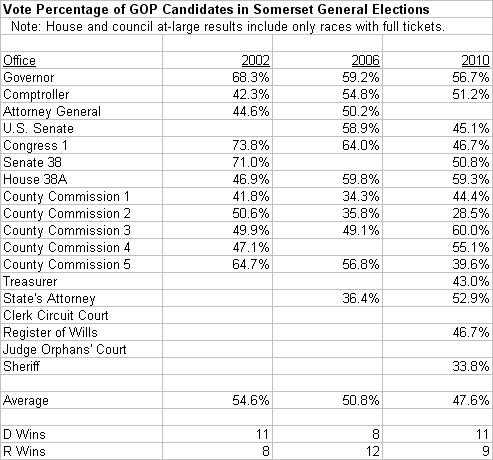
Republican candidates do better at the top of the ticket and Democrats do better for county offices. In the last three cycles, the Democrats had 8-5 margins for county seats. Somerset is another county that voted for Ehrlich, Mikulski and Kratovil.
Wicomico County
1.6% of Registered Voters (15th)
Leans Republican
Most Republicans win here, but the success of a few prominent Democrats like County Executive Rick Pollitt and Delegates Norman Conway and Rudolph Cane prevent us from classifying this jurisdiction as Solid Republican.
Worcester County
1.0% of Registered Voters (17th)
Leans Republican
Like several other Eastern Shore counties, Worcester has tended to vote for Republicans for state office and Democrats for county office. But this year, the GOP won five of seven County Commission seats and voters supported both Eric Wargotz and Andy Harris. That puts Worcester in the Republicans’ corner for now.
We’ll summarize all of our results tomorrow.
Wednesday, November 10, 2010
Party Performance in Baltimore County, Harford County and the Upper Shore
How do the parties do in Baltimore County, Harford and the upper shore?
Baltimore County
14.2% of Registered Voters (3rd)
Leans Democrat
Republicans win seats in the districts Baltimore County shares with Carroll County (Legislative District 5) and Harford County (Legislative District 7). Otherwise, Democrats win most of the time, especially in districts that border the city. The fact that Governor Martin O’Malley almost defeated former Baltimore County Congressman Bob Ehrlich here this year says something about this jurisdiction. Here’s another fact: in the 54 years that the County Executive office has been in existence, the GOP has occupied it in just eight years. And one of those occupants was Spiro Agnew.
Harford County
4.3% of Registered Voters (7th)
Solid Republican
Harford has largely completed a transition to GOP control that took about twenty-five years. The Democrats did not bother to run candidates for County Executive or a majority of County Council seats this year. All three Senators and seven of eight Delegates are Republicans.
Cecil County
1.7% of Registered Voters (12th)
Solid Republican
Cecil is a rare GOP success story in Maryland. Eight years ago, most of its elected officials were Democrats. This year, voters supported just three Democrats: Delegate David Rudolph, the county’s Register of Wills and one Judge of the Orphans’ Court. (Unopposed Attorney General Doug Gansler is the fourth Democratic “win.”) Can the GOP learn anything from Harford and Cecil Counties that could help it build strength in the rest of the state?
Kent County
0.4% of Registered Voters (24th)
Split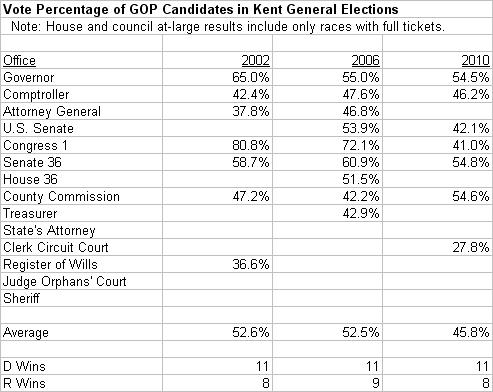
Kent County, the smallest jurisdiction in Maryland, goes both ways. Its District 36 statehouse delegation is totally Republican. Its county government is dominated by Democrats. Kent voted for Ehrlich but also voted for Mikulski and Kratovil this year – an unusual combination.
Queen Anne’s County
0.9% of Registered Voters (18th)
Solid Republican
The only Democrats who won this year in Queen Anne’s were the Register of Wills, the State’s Attorney and Gansler. The latter two ran unopposed. The GOP had just one seat on the County Commission in 2006. This year they swept all five.
We’ll look at the Central and Lower Eastern Shore tomorrow.
Tuesday, November 09, 2010
Atterbeary Linked to Ehrlich Voter Suppression Robocaller
The Baltimore Sun has reported that former District 18 House candidate Vanessa Atterbeary employed Julius Henson, the campaign operative who was responsible for voter suppression robocalls for Bob Ehrlich in Baltimore. The Sun says Henson has “a history of rough-and-tumble campaign tactics” and links him to what happened this summer in District 18.
The Sun refers to Vanessa Atterbeary’s misleading mailer in which she inaccurately claimed to have the support of several elected officials. We reprint an excerpt from her mailer below.
Six of these officials denied endorsing Atterbeary or permitting their images to be used in her literature. None of these officials confirmed their support for her. Atterbeary herself blamed a “printing error” and said, “That should not have gone out.” MPW first commented on the mailer on August 30. Atterbeary paid Universal Elections, one of Henson’s companies that later made the suppression robocalls, $19,000 for “direct mailing by mail house” on August 26.
The mailer was not the only noteworthy event during the primary. Atterbeary’s campaign made illegal robocalls, covered the district with illegal signs as early as May, received a warning from the Town of Kensington and damaged voters’ cars. During this period of time, Atterbeary paid Henson’s companies – Universal Elections and Politics Today Inc. – $79,489.99. Those payments accounted for 62% of her total campaign spending through 8/27/10.
She may have paid Henson even more but her pre-general election campaign finance report is more than two weeks overdue.
Disclosure: The author is the Treasurer of the District 18 Democratic Team.
Party Performance in Western Maryland
Welcome to rural and mountainous Western Maryland, a region almost as unfriendly to Democrats as is Baltimore City to Republicans.
Frederick County
4.0% of Registered Voters (8th)
Solid Republican
Shifting voter registrations have caused some to believe that Frederick is trending Democratic. Not so fast. The Democrats had only three wins here this year: Ron Young’s narrow defeat of Senator Alex Mooney, Delegate Galen Clagett’s reelection and Doug Gansler’s unopposed candidacy. The third “win” doesn’t really count and Mike Miller had to invest tens of thousands of dollars in negative mail to take down Mooney. The GOP won every County Commission election and the Democrats did not come close. Even the City of Frederick, the most Democratic area in the county, has a Republican Mayor. The Democrats may have to redistrict a piece of Montgomery County, maybe Clarksburg, into Young’s district to save his seat.
Carroll County
3.0% of Registered Voters (9th)
Solid Republican
William Donald Schaefer (running for Comptroller in 2002) and Doug Gansler (running unopposed for Attorney General this year) are the only Democrats to score wins here in the last three cycles.
Washington County
2.4% of Registered Voters (11th)
Solid Republican
The only Democrats who won state or county office here in 2010 are Gansler, Delegate John Donoghue, the Treasurer and the Clerk of the Circuit Court (who both ran unopposed), the Register of Wills and the Sheriff. The GOP controls both the state delegation and the county government. The voters even elected this guy to a Delegate seat. Frederick Democratic Senator-elect Ron Young will represent a small piece of the county in Annapolis.
Allegany County
1.2% of Registered Voters (16th)
Solid Republican
Delegate Kevin Kelly will be the county’s only Democratic elected officeholder this term.
Garrett County
0.5% of Registered Voters (21st)
Solid Republican
The only ways for a Democrat to win here might be to run unopposed (as did Gansler) or for the Republican candidate to die right before the election. That actually happened this year and the GOP still won with a write-in candidate.
There is no question that the Republicans thoroughly dominate Western Maryland. The problem is that its five counties only account for 11% of the state’s registered voters – just slightly more than Baltimore City. The GOP needs to add a lot more reliable areas before it can be truly competitive on a statewide level.
We’ll look at Baltimore and Harford Counties and the upper Eastern Shore tomorrow.
Monday, November 08, 2010
Party Performance in Central and Southern Maryland
Last week, we analyzed Republican electoral performance in Maryland’s three Democratic strongholds: Baltimore City and Montgomery and Prince George’s Counties. The conventional wisdom is that while the Democrats always carry those counties, the GOP carries the rest of the state. But is that really true? We will look at GOP performance in state and county elections in the state’s other twenty-one jurisdictions this week to find out.
A note on methodology. We use two measures for party performance over the last three cycles. One is the average vote percentage earned by Republican candidates running in the county. Unopposed candidates and races without full tickets (for example, a Delegate race in which one party fields less than a full slate) do not count. Statewide candidate performances do count. The other measure is the number of Democratic and Republican wins in a district. If a candidate in a multi-county district wins the county but loses the entire district, that still counts as a win. Unopposed candidates do count on this measure. Based on these two criteria in 2002, 2006 and 2010 general elections, we evaluate whether each county is solid for one party, leans to one party or is evenly split.
Anne Arundel County
9.5% of Registered Voters (5th)
Split
This is the most competitive jurisdiction in the state. Both parties have districts where they are strong. Some districts (like Speaker Mike Busch’s District 30) are places where either party can win. The state delegation currently has three Democratic Senators, two Republican Senators, seven Democratic Delegates and eight Republican Delegates. The County Council has three Democrats and four Republicans. Anne Arundel Republicans are diverse, including relative moderates like Delegates Steve Schuh and Bob Costa and conservatives like Delegates Don Dwyer and Tony McConkey.
Howard County
5.1% of Registered Voters (6th)
Leans Democrat
Howard is politically split between its eastern and southern region (along I-95) and its northern region (along I-70). The former area elects Democrats to the County Council and the delegation whereas the latter area elects Republicans. Because most of the county’s population lives near I-95 and the majority of its districts are in that area, Democrats hold most of the elected offices.
Calvert County
1.6% of Registered Voters (14th)
Leans Republican
This county was evenly split before 2010, when the GOP grabbed the upper hand. Most GOP candidates won majorities here. The only reason some of the Democratic state legislators were reelected is because they share districts with Prince George’s and Saint Mary’s Counties. Democratic Delegate Sue Kullen, the only legislator whose district is entirely inside the county, was defeated by a Republican. The GOP also won all five seats on the County Commission. Look for the Democrats to prevent the creation of any more all-Calvert legislative districts in redistricting.
Charles County
2.6% of Registered Voters (10th)
Solid Democrat
Charles is Maryland’s fastest growing jurisdiction and one of its most Democratic. Eight years ago, the county was split between the parties, but that has changed along with mass emigration from the Washington suburbs. Republicans narrowly won the county’s small piece of Legislative District 29 but still lost overall. The county no longer has any GOP officeholders. Charles’s population growth will give it at least one Delegate seat in redistricting, and it will almost certainly be occupied by a Democrat.
Saint Mary’s County
1.7% of Registered Voters (13th)
Split
Saint Mary’s used to lean Democratic but is now evenly split. It has a Democratic Senator, two Democratic Delegates and one Republican Delegate (House Minority Leader Tony O’Donnell). Four of its five County Commission Members are Republicans. Democratic Senator Roy Dyson and Democratic Delegate John Wood, both veterans, won reelection by tiny margins.
We’ll look at Western Maryland tomorrow.
Thursday, November 04, 2010
Republican Performance in the Democratic Big Three
Following are the percentages gained by Republican candidates in Baltimore City, Montgomery County and Prince George's County since 2002. Races with no GOP candidate or with incomplete tickets are not included. Together, these three jurisdictions accounted for 42% of Maryland's registered voters in 2010.
Montgomery County: The great GOP tidal wave of 2010 caused an average Republican gain of 2.9 points in MoCo. No Republicans were elected in 2006. No Republicans were elected in 2010. (The county does have six precincts in Congressional District 6 that vote for Republican Roscoe Bartlett.)
Prince George's County: The Republicans' vote percentage has declined steadily since 2002. They did not bother to contest the majority of elections in the county in 2010.
Baltimore City: Just as in Prince George's, the GOP's performance is so poor that they often do not bother running candidates in Baltimore City. And the chart below does not include the Republicans' losses in city government races, which are held in odd-numbered years.
Here is the GOP's record in the three Democratic strongholds together.
How are the Republicans supposed to compete statewide if they cede these three jurisdictions to the Democrats?
Wednesday, November 03, 2010
Now Comes the Hard Part
Today, Maryland Democrats are celebrating the reelection of Governor Martin O’Malley, U.S. Senator Barbara Mikulski and their holding onto both chambers of the General Assembly. But the reality of governance will soon set in. Why?
Because the Republicans have won control of the U.S. House of Representatives, and that means federal stimulus aid for the state government has almost certainly dried up.
Maryland’s state government has been subsidized by federal stimulus money under ARRA (the American Recovery and Reinvestment Act of 2009) for three fiscal years: 2009, 2010 and 2011. According to the state’s latest Spending Affordability Committee report, the state government has received $4.4 billion of stimulus funding over the last three fiscal years. The largest subsidies have been directed to Medicaid ($1.6 billion), education ($1.1 billion) and infrastructure ($781 million).
The stimulus funds have been invaluable for closing Maryland’s general fund deficits. In FY 2009, 2010 and 2011, the state racked up $6.4 billion in structural general fund deficits. It has used $2.9 billion of federal stimulus money to help close those deficits. That means federal money has been used to plug almost half of Maryland’s budget gaps.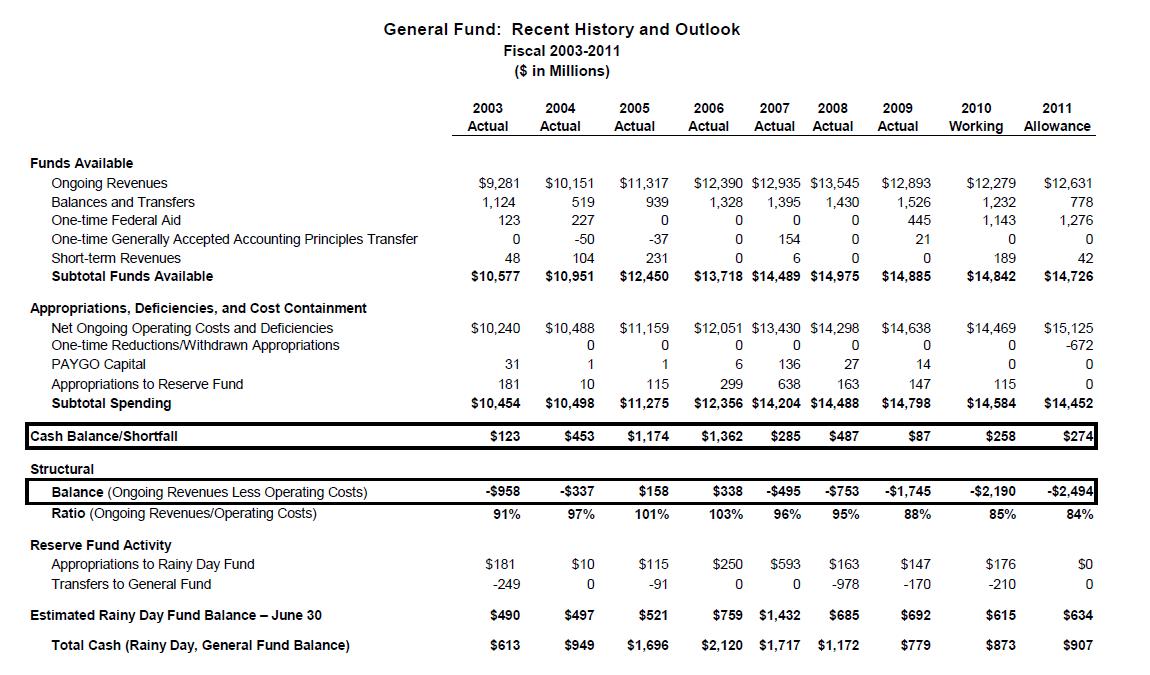
With the election of a Republican U.S. Congress, that money is gone. And Maryland faces a general fund deficit in FY 2012 that could be as high as $1.6 billion. That leaves a number of unappetizing options to deal with it.
Budget Cuts
In FY 2011, 41% of all state general fund spending was sent as aid to local governments. By spending category (which overlaps local aid), 50% of the general fund goes to education, 24% goes to health care and 9% goes to public safety. Those three items combined account for 84% of the general fund in FY 2011. It’s probably impossible to have meaningful long-term spending cuts without touching one or more of these areas.
Teacher Pensions
In the 2010 session, the Senate passed a plan to phase in a partial handoff of teacher pension obligations to the counties. The plan would have saved the state no money in FY 2011, $63 million in FY 2012, $194 million in FY 2013 and more than $300 million annually in the out years. Those out year revenues are significant, but the state’s budget problems may necessitate collection of them earlier. So the General Assembly could well choose to accelerate the phase-in and make the counties assume a greater share of the cost than in the Senate’s plan.
Diversion of Transportation Revenues
The Transportation Trust Fund (TTF) claims over $800 million a year in state funding. The TTF’s revenues include vehicle titling fees (20%), gas taxes (19%), registration fees (15%), operating revenues (10%), sales taxes (6%), corporate income taxes (4%) and more. All are ripe for diversion to the general fund. The General Assembly has already seized transportation money due to the counties so state transportation money could be next. That would be a disaster for the state’s infrastructure, but if transportation advocates are pitted against education advocates, who do you think will win?
Tax Hikes
The three most discussed taxes are an extension of the millionaire tax (which was supposed to last for three years), the imposition of combined reporting to capture more corporate income taxes and an extension of the sales tax to services. The first two options will be resisted by the business community and both have very uncertain revenue generating capabilities. The last time the state tried to extend the sales tax to services, the result was the much-hated computer tax (which was repealed in 2008).
Casting a long shadow over the taxation debate is the state’s competitive position with its neighbors – especially Virginia. The Tax Foundation’s FY 2011 tax competitiveness report ranks Delaware #8, Virginia #12, Pennsylvania #26, West Virginia #37 and Maryland #44 of the fifty states. Here is how Maryland compares to Virginia on a few tax measures.
Corporate Income Tax
Maryland: 8.25%
Virginia: 6.00%
Top Income Tax Rate
Maryland: 6.25% (at $1 million income)
Virginia: 5.75% (at $17,000 income)
Sales Tax
Maryland: 6%
Virginia: 5%
Maximum Unemployment Insurance Tax Rate
Maryland: 13.5%
Virginia: 6.2%
At least the state will not have to pay for Bob Ehrlich’s proposed $700 million sales tax cut.
Now what were we saying about celebrating?
Tuesday, November 02, 2010
Democrats Lead in Early Voting - Without MoCo and Baltimore
Democrats performed better in early voting than Republicans despite subpar turnouts in Montgomery County and Baltimore City.
Here is a chart contrasting voter registration and early voting percentages by party.
The Republicans' early voting matched their voter registration percentage. The Democrats beat their registration percentage by 7.5 points.
One reason for the Democrats' advantage would be if their party organizations in their three strongholds - Baltimore City and Montgomery and Prince George's Counties - aggressively turned out early votes. But that has not been the case. Here is a chart contrasting voter registration and early voting percentages by county.
Prince George's County was the only jurisdiction in the Democrats' Big Three to beat their registration percentage in early voting. Both Baltimore and MoCo, and the Big Three together, lagged.
So the Democrats beat the GOP in early voting mostly by relying on party members outside their strongholds. That should be an encouraging sign for Martin O'Malley.
Our Forecast: Ehrlich vs. O’Malley
Who’s going to win the Maryland Governor’s race today? We know the answer, so read on to find out!
OK, we don’t know the answer, but we are going to take our best shot at predicting the outcome. And we will not do it using party talking points, ideology, impassioned appeals or all that other pap. We will rely on what truly matters on Election Day: mathematics.
Our projections are derived from three sets of estimates:
1. Registration by party
2. Turnout by party
3. Voting intention by party
Of these three, only registration is known. Here is the number of voters by party who are eligible to vote in today’s general election.
Registration alone will not determine the election. Here are the turnout rates by party for the last three gubernatorial general elections, as well as a forecast by Gonzales Research in its latest poll.
Democrats and Republicans turned out at about the same rate in 1998. Since then, Republicans have had a four-point edge. Independents and members of other parties are much less likely to vote. Gonzales estimates that 2010 will be a very different year for turnout and we will discuss that later.
Now here is Bob Ehrlich’s support by party in four different polls.
1. A Survey USA poll taken in November 2002 48 hours before the election. This shows Ehrlich’s support by party in the year that he won.
2. A CNN exit poll taken in November 2006. This shows Ehrlich’s support by party in the year that he lost.
3. The average levels of Ehrlich’s support by party from three October 2010 polls by Gonzales, the Baltimore Sun and the Washington Post.
4. Ehrlich’s support by party from a July 2010 poll by Magellan. This poll, which showed Ehrlich up three points on O’Malley, was Ehrlich’s best poll of the cycle.
Every poll had undecideds except the CNN exit poll. We allocated undecided voters with their party and split independents down the middle so as not to understate Ehrlich’s support.
Taken together, these sets of numbers can be used to construct projections for the race. By plugging in different sets of assumptions about turnout or party voting behavior, we can estimate a range of outcomes for both Ehrlich and O’Malley. We assembled three models.
General Election Model One
In our first model, we assume that turnout will be the same as in 2002 (which was the year Ehrlich won) and that party members will vote in accordance with the average of the three October 2010 polls. The outcome under these assumptions is an 18.4 point blowout for O’Malley.
Now, this is not going to happen. The primary reason is Democratic turnout. The number of registered Democrats eligible to vote in the general election has gone from 1.557 million in 2002 to 1.957 million today. Many of the new Democrats registered during the run-up to President Obama’s election. It is unreasonable to expect all of them to turn out at the same rate as the older, long-term Democrats. Furthermore, Gallup is forecasting heavy turnout nationwide for the GOP. No pollster expects that Republicans will have a four-point turnout edge this year. It’s far too narrow for today’s wave election.
General Election Model Two
In our second model, we are using Gonzales’s turnout forecast – 70% for Republicans, 55% for Democrats and 40% for others – along with the October poll party voting assumptions. Gonzales’s forecast provides for an unprecedented GOP edge in Maryland, but given what happened in the primaries, it is probably justified. Primary election day turnout for Maryland Democrats was 37% in 2002, 33% in 2006 and 25% this year. Primary election day turnout for Maryland Republicans was 30% in 2002, 25% in 2006 and 29% in 2010. That’s a HUGE dropoff for Democrats that has party leaders concerned. The outcome under these assumptions is a 13.2 point win for O’Malley.
O’Malley still wins big because Ehrlich’s support among Democrats is so low. As we showed yesterday, the four most recent polls showed Ehrlich getting just 7-19% of Democrats – far less than the 29% he scored right before the 2002 election. But what if critics of these polls like Blair Lee are right? What if survey problems are underestimating Ehrlich’s appeal to Democrats?
General Election Model Three
The best poll for Ehrlich in the entire cycle was Magellan’s July 2010 survey, which showed him getting 25% of Democrats and winning by three. Magellan works primarily for Republicans, so their estimates may be the best that Ehrlich will ever get. Also, this poll was taken before most of O’Malley’s attack ads hit. In our third model, we use Gonzales’s turnout forecast and Magellan’s party voting estimates. Under these assumptions, O’Malley wins by 1.8 points.
This illustrates Ehrlich’s fundamental problem: even under the most favorable turnout and party voting assumptions, he loses. He is not matching the appeal he had to Democrats in 2002 and the GOP is not large enough to carry him to victory.
So what will be the margin? Model One is totally unrealistic. Model Two is too lenient to the Democrats. Model Three is too lenient to the Republicans. So let’s split the difference between Models Two and Three.
O’Malley by 7.5.

